10 Best Synthesizers 2026 in the United States
Related Products
Up to 9% off


Our technology thoroughly searches through the online shopping world, reviewing hundreds of sites. We then process and analyze this information, updating in real-time to bring you the latest top-rated products. This way, you always get the best and most current options available.

Our Top Picks
Winner
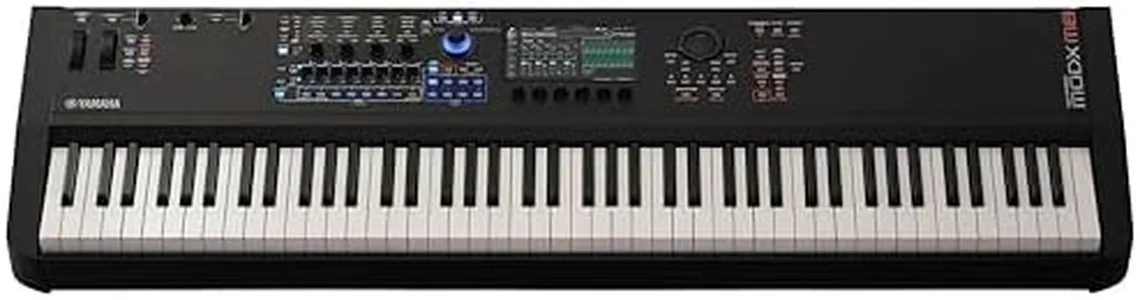
Yamaha 88-Key Music Synthesizer, Graded Hammer Action, Realistic Feel, Performance Focused for Next Generation Sound Exploration, Expressive Control and Optimized Workflow MODX M8
Most important from
9 reviews
The Yamaha MODX M8 is a professional 88-key synthesizer designed with pianists in mind, offering a realistic playing experience thanks to its graded hammer action keyboard that feels heavier in the low keys and lighter in the high keys. It features three powerful sound engines that combine classic analog synthesis, modern FM synthesis, and realistic acoustic instruments, giving you a broad palette of sounds for creative exploration. With 88 keys and advanced sequencing options, it supports complex performances and compositions.
The synthesizer excels in expressive control, featuring eight physical faders and a Super Knob for hands-on real-time sound manipulation, complemented by an intuitive color touchscreen and dedicated knobs for quick editing. This makes navigating sounds and tweaking parameters straightforward, even if you’re not deeply technical. Connectivity-wise, the MODX M8 seamlessly integrates with music software via the Expanded Softsynth Plugin, allowing you to create and edit sounds right in your digital audio workstation (DAW).
Weighing 40.5 pounds, it is relatively light for an 88-key keyboard, though it might still be less portable for frequent gigging compared to smaller synths. The MODX M8 is best suited for serious musicians who want a versatile, performance-focused synthesizer with quality piano feel and broad synthesis options, rather than beginners looking for a simpler setup.
Most important from
9 reviews
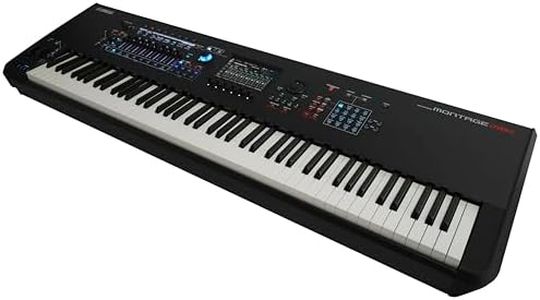
Yamaha Montage M8X 88-Key Flagship Music Synthesizer with GEX action featuring Polyphonic Aftertouch for New Sound Exploration and Expressive Control
Most important from
9 reviews
The Yamaha Montage M8X is a top-tier synthesizer designed for musicians looking for powerful sound creation and expressive control. It blends various synthesis types, including analog modeling (AN-X), sample-based sounds (AWM2), and advanced FM synthesis (FM-X), giving you a wide palette of tones from classic to modern. With an impressive 400-note polyphony, it can handle complex layers without cutting off sounds, which is great for studio work and live performances.
The 88-key keyboard features GEX action with polyphonic aftertouch, offering a sensitive and dynamic playing experience that responds well to your touch. Yamaha’s large wave memory and user memory allow for a rich variety of sounds and customization. Connectivity is straightforward with USB, making it easy to integrate with other gear or computers. The M8X is quite heavy and large, so it may not be the best choice if you need something portable. Also, while its features are extensive, the interface might have a learning curve if you’re new to advanced synthesizers.
This instrument is well suited for serious musicians and producers who seek a versatile, expressive synthesizer with a broad sonic range.
Most important from
9 reviews
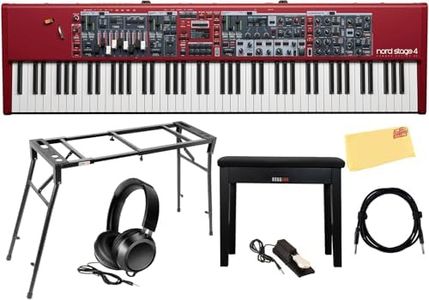
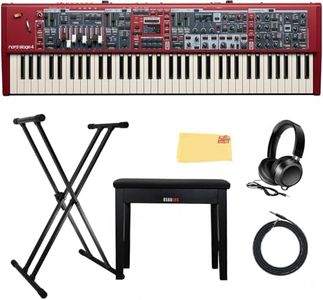
Nord Stage 4 88 Digital Piano Bundle with Adjustable Stand, Bench, Sustain Pedal, Headphones, Instrument Cable, and Austin Bazaar Polishing Cloth
The Nord Stage 4 88 is a versatile synthesizer and digital piano aimed at musicians who want a powerful yet accessible instrument for live performance and studio use. Its synth section stands out by combining three independent layers powered by the Nord Wave 2 engine, offering virtual analog, FM, wavetable synthesis, and a rich sample library. This means you have a wide range of sounds from classic synth tones to realistic strings and choirs. The polyphony is generous enough to handle complex layering, aided by an advanced arpeggiator with multiple modes and customizable patterns, which adds rhythmic and melodic complexity easily.
The organ simulations are particularly impressive, featuring award-winning models of classic B3, Vox/Farfisa, and Pipe Organs complete with physical drawbars and LED indicators for intuitive control. This gives users an authentic organ-playing experience that’s rare in digital keyboards. Effects have also been significantly expanded, including new reverbs, delays, and modulation options, allowing for creative sound shaping. Connectivity options include USB, MIDI, and auxiliary ports, making it compatible with software (DAWs) and external gear, which is great for both live setups and studio integration. The user interface is thoughtfully designed with dedicated LED faders for each layer, simplifying sound editing and live adjustments without diving into menus.
The bundle adds practical value with an adjustable stand, comfortable bench, a high-quality sustain pedal with dynamic noise control, headphones, instrument cable, and a polishing cloth, making it ready to play right out of the box. With 88 keys and a weight of 30 pounds, it’s less portable than smaller synths, so it’s best suited for stationary use or touring musicians with transport support. While it covers many synthesis types well, those seeking deep modular-style synthesis might find it less flexible. The plastic build is sturdy but may not feel as premium as some high-end competitors. This instrument is ideal for serious keyboard players who want a powerful, all-in-one synth and piano setup with excellent organ sounds, flexible layering, and a user-friendly interface, making it perfect for live performers and studio musicians who value a broad sonic palette and hands-on control.