We Use CookiesWe use cookies to enhance the security, performance, functionality and for analytical and promotional activities. By continuing to browse this site you are agreeing to our privacy policy

10 Best Portable Generators Rating 2026 in the United States
How do we rank products for you?

Our technology thoroughly searches through the online shopping world, reviewing hundreds of sites. We then process and analyze this information, updating in real-time to bring you the latest top-rated products. This way, you always get the best and most current options available.

headphones-stars

Our Top Picks

#1

Winner

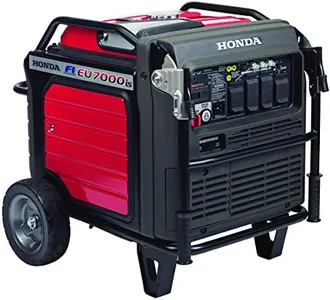
Honda EU7000IS 7,000 Watt Inverter Portable Backup Generator, Super Quiet, Electric Start

Rating
10.0
Chosen by1,141
Power Output (Wattage)
Noise Level

Most important from
28 reviews

Power Output (Wattage)
The generator starts immediately and runs much quieter than older models, providing steady and reliable power output.
Noise Level
Its quiet operation, staying between 58-62 decibels, ensures it won't disturb you or your neighbors.

The Honda EU7000IS is a strong choice for anyone needing reliable backup power at home, for RVs, or outdoor events. It offers a robust starting wattage of 7,000 watts and a running wattage of 5,500 watts, which is enough to power multiple appliances or tools simultaneously. The generator runs on fuel and provides about 6.5 hours of operation on a single tank, which is decent for its power level but may require refueling for longer use. It features an electric start, making it easy to turn on without manual effort.

Though it weighs 270 pounds and measures 28"x28"x34", which makes it less portable compared to smaller models, its design is suited for those who prioritize power and quiet operation over lightness. This model is known for being super quiet relative to typical generators, making it more comfortable for use in neighborhoods or campsites. Connectivity is modern with Bluetooth and an app for monitoring, which is a nice convenience. Safety is well-covered with Honda’s CO-MINDER system that detects carbon monoxide levels, adding peace of mind during use. It includes three power outlets, which should accommodate most common devices. The 3-year residential warranty reflects Honda’s confidence in durability.

Its considerable weight and size mean it’s not the best for frequent transport, and 6.5 hours of runtime might feel short if extended power without refueling is needed. The Honda EU7000IS is a dependable, quiet, and feature-rich portable generator suited for users who need solid power output and advanced safety in a mostly stationary setup.

Rating
10.0
Chosen by1,141
Power Output (Wattage)
Noise Level

Most important from
28 reviews

Power Output (Wattage)
The generator starts immediately and runs much quieter than older models, providing steady and reliable power output.
Noise Level
Its quiet operation, staying between 58-62 decibels, ensures it won't disturb you or your neighbors.
#2

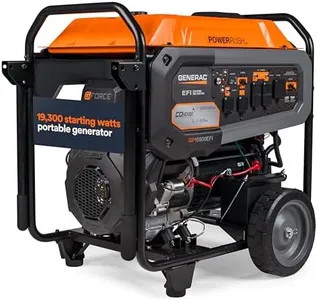
Generac 19,300 Starting Watt Portable Gas Generator - Electric Start - Home Backup or RV Ready - Heavy Duty Frame - Quiet, Long Runtime, Emergency Power - 49-State Compliant

Rating
9.4
Power Output (Wattage)
Portability
Noise Level

Most important from
12 reviews

Power Output (Wattage)
Starts reliably and provides steady power for essential needs without hassle.
Portability
Extremely easy to operate right out of the box, making setup and use straightforward.
Noise Level
Noise level is reasonable considering its power output and size.

The Generac 7705 GP15500EFI is a powerful portable gas generator designed for home backup and heavy-duty use, offering 15,500 running watts and 19,300 starting watts, which is enough to power most household appliances and tools during outages or on job sites. It runs on gasoline with a 5-gallon tank giving you extended runtime, and includes a fuel gauge for easy monitoring. This model features an electric start for convenience and an 816cc engine with electronic fuel injection, which helps it run efficiently and reliably.

Portability is supported by a strong steel frame, heavy-duty never-flat wheels, and a wheelbarrow-style handle, but keep in mind it weighs 450 pounds, making it more suitable for occasional relocation rather than frequent moving. The generator includes six outlets, providing good connectivity options for different devices. Safety-wise, it has integrated COsense carbon monoxide detection technology that alerts you if dangerous fumes are present, and it automatically shuts down when oil levels are low to protect the engine.

Noise levels are described as quiet for its category, though it isn’t as silent as smaller, inverter models. Built tough to handle rough conditions and compliant with 49-state emissions regulations, the size and weight may be a drawback if you need something more compact or lightweight. This generator is a solid choice for anyone needing reliable, high-powered emergency backup or job site power with useful safety features, but it may be less ideal for casual or highly portable use.

Rating
9.4
Power Output (Wattage)
Portability
Noise Level

Most important from
12 reviews

Power Output (Wattage)
Starts reliably and provides steady power for essential needs without hassle.
Portability
Extremely easy to operate right out of the box, making setup and use straightforward.
Noise Level
Noise level is reasonable considering its power output and size.
#3

Westinghouse 28000 Peak Watt Home Backup Portable Generator, Remote Electric Start with Auto Choke, Transfer Switch Ready 30A & 50A Outlets, Gas Powered, CO Sensor,Blue

Rating
9.1
Power Output (Wattage)
Fuel Type
Portability

Most important from
173 reviews

Power Output (Wattage)
This generator delivers massive power capable of running an entire house, including heavy appliances like a 5-ton AC and 220-volt dryer without issues.
Fuel Type
It runs exceptionally well in cold climates when using synthetic oil, ensuring reliable operation in diverse environments.
Portability
The robust frame and solid wheels make moving this nearly 700-pound machine manageable, especially with proper equipment.
Noise Level
Despite its size, it operates with less noise than some smaller competitors, making it surprisingly quieter for a generator of this capacity.
Outlets and Connectivity
The multiple breakers and abundant outlets provide excellent flexibility for powering various devices and nearby workshops safely.

The Westinghouse 28000 Peak Watt Portable Generator is a strong choice for homeowners needing a powerful backup solution during outages. With 20,000 running watts and 28,000 peak watts, it can support large appliances and multiple devices simultaneously. It runs on gasoline with a large 17-gallon fuel tank, offering up to 17 hours of operation at 25% load, which is excellent for extended power outages. The generator includes a remote electric start with a key fob and push-button option, making it convenient to operate from a distance.

It offers a wide array of outlets, including standard household plugs, 120/240V outlets, and transfer switch-ready options, allowing flexible connection to home circuits and various equipment. Safety is well addressed through features like an automatic CO sensor shutdown, low oil shutdown, and GFCI outlets with protective covers, enhancing peace of mind during use. The unit is designed to produce clean power with low harmonic distortion, which helps protect sensitive electronics like computers and TVs.

This generator is quite heavy at over 600 pounds, which impacts portability despite having reinforced steel handles. It is better suited for stationary use rather than frequent transport. Noise levels are not explicitly detailed but heavy-duty generators in this wattage range typically generate noticeable sound, so some noise should be expected. Setup is straightforward with included oil, funnel, and clear instructions, but the size and weight mean you’ll need a solid place to store and operate it. This generator is ideal for those who want a robust and reliable home backup power source capable of running many devices safely for long periods. It performs strongly in terms of power, run time, safety, and connectivity, though portability and noise might be less favorable for users needing frequent moves or quieter operation.

Rating
9.1
Power Output (Wattage)
Fuel Type
Portability

Most important from
173 reviews

Power Output (Wattage)
This generator delivers massive power capable of running an entire house, including heavy appliances like a 5-ton AC and 220-volt dryer without issues.
Fuel Type
It runs exceptionally well in cold climates when using synthetic oil, ensuring reliable operation in diverse environments.
Portability
The robust frame and solid wheels make moving this nearly 700-pound machine manageable, especially with proper equipment.
Noise Level
Despite its size, it operates with less noise than some smaller competitors, making it surprisingly quieter for a generator of this capacity.
Outlets and Connectivity
The multiple breakers and abundant outlets provide excellent flexibility for powering various devices and nearby workshops safely.

Buying Guide for the Best Portable Generators Rating

Choosing the right portable generator can be a daunting task, but with the right approach, you can find a model that perfectly suits your needs. Portable generators are essential for providing power during outages, for outdoor activities, or for use on job sites. To make an informed decision, you need to understand the key specifications and how they relate to your specific requirements. Here’s a guide to help you navigate through the important specs and choose the best portable generator for you.
Power Output (Wattage)Power output, measured in watts, indicates how much electricity the generator can produce. This is crucial because it determines what and how many devices you can power simultaneously. Generators typically range from 1,000 to 10,000 watts. For light use, such as camping or running small appliances, a generator with 1,000 to 2,000 watts is sufficient. For home backup during outages, look for 3,000 to 5,000 watts. For heavy-duty use, such as on construction sites, you may need 6,000 watts or more. Assess your power needs by listing the devices you plan to run and their wattage requirements.
Fuel TypePortable generators can run on various fuels, including gasoline, propane, and diesel. Gasoline is the most common and widely available, but it has a shorter shelf life and can be less efficient. Propane is cleaner and has a longer shelf life, but it requires a separate tank. Diesel is more efficient and has a longer lifespan, but diesel generators are typically more expensive and noisier. Choose a fuel type based on availability, storage, and your specific use case. For occasional use, gasoline might be convenient, while for long-term or frequent use, propane or diesel could be more practical.
Run TimeRun time refers to how long the generator can operate on a full tank of fuel. This is important for ensuring continuous power without frequent refueling. Run times can vary significantly, from a few hours to over 12 hours. For short-term use, such as during a camping trip, a generator with a 4-6 hour run time may be adequate. For home backup or extended use, look for models with 8-12 hours or more. Consider your typical usage duration and choose a generator that can meet your needs without constant refueling.
PortabilityPortability is a key factor, especially if you plan to move the generator frequently. This includes the weight, size, and design features like wheels and handles. Lightweight generators (under 50 pounds) are ideal for camping and light use. Medium-weight generators (50-100 pounds) are suitable for home backup and moderate use. Heavy-duty generators (over 100 pounds) are best for job sites and heavy use but should have wheels and handles for easier transport. Assess how often and where you will move the generator to determine the right level of portability.
Noise LevelNoise level, measured in decibels (dB), indicates how loud the generator will be during operation. This is important for comfort and compliance with noise regulations. Generators can range from 50 dB (quiet) to over 80 dB (loud). For camping or residential use, a quieter generator (50-60 dB) is preferable to avoid disturbing others. For job sites, noise may be less of a concern, so a louder generator (70-80 dB) might be acceptable. Consider where you will use the generator and choose a noise level that suits your environment.
Outlets and ConnectivityThe number and type of outlets determine what devices you can connect to the generator. Common outlets include standard 120V household outlets, 240V outlets for larger appliances, and USB ports for charging electronics. Some generators also offer RV-ready outlets or twist-lock outlets for secure connections. Assess your power needs and ensure the generator has the appropriate outlets for your devices. For example, if you need to power an RV, look for a model with an RV outlet. For home use, ensure there are enough 120V outlets for your appliances.
Safety FeaturesSafety features are crucial for preventing accidents and ensuring safe operation. Key features include automatic shutoff for low oil levels, overload protection, and carbon monoxide detectors. These features help protect both the generator and the user. For home use, especially in enclosed spaces, a generator with a carbon monoxide detector is essential to prevent poisoning. For general use, look for models with automatic shutoff and overload protection to ensure safe and reliable operation. Prioritize safety features based on your usage environment and potential risks.

FAQ